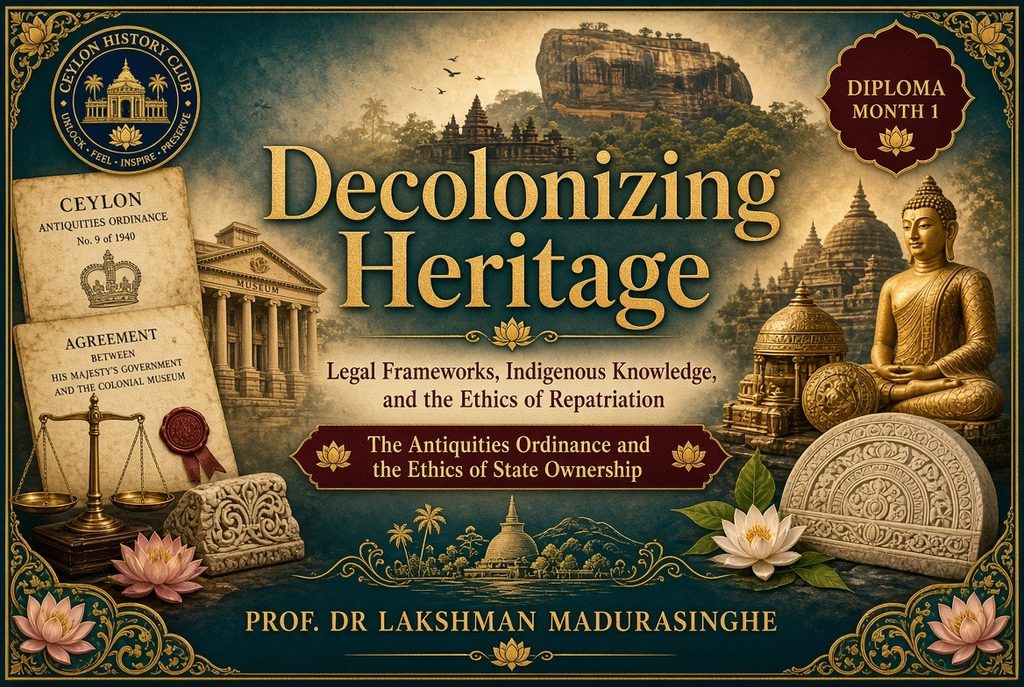
Prof. Dr Lakshman Madurasinghe
The Antiquities Ordinance and the Ethics of State Ownership
Diploma in Heritage Studies- Month 1
In Sri Lanka, the primary statutory framework governing cultural property is the Antiquities Ordinance No. 9 of 1940. Under Section 2 of this legislation, all undiscovered antiquities—whether lying on or hidden beneath the surface of the ground—are deemed the absolute property of the State. This centralized legal mechanism demonstrates a specific administrative Competence, representing the strategic skills and administrative capabilities of the state. This effectively curbs illicit excavations, regulates archaeological research, and prevents the black-market trafficking of historical artifacts.
However, this top-down bureaucratic control raises significant ethical concerns regarding community rights. When the state asserts absolute property rights over antiquities and historical sites, it can inadvertently alienate local communities from their ancestral landscapes. Heritage ethics increasingly questions whether state ownership inherently respects the customary rights of indigenous and local populations who have maintained spiritual, cultural, and historical ties to these environments for millennia.
Intellectual Property and the Safeguarding of Indigenous Knowledge
The preservation of heritage extends beyond tangible monuments into the realm of intangible cultural heritage and indigenous knowledge, encompassing traditional medicine, agricultural practices, and folklore. Current intellectual property (IP) regimes are fundamentally ill-equipped to protect knowledge that is communal, intergenerational, and orally transmitted.
Establishing a true Commitment—defined as the steadfastness and clarity of long-term, ultimate objectives—to heritage ethics requires moving beyond conventional IP laws to develop sui generis (unique) legal frameworks. These specialized frameworks must recognize collective community rights, ensure equitable benefit-sharing, and protect the intellectual legacy of indigenous populations from unauthorized commodification by global corporate interests.
The Global Repatriation Debate and Reparative Justice
The international debate surrounding the repatriation of colonial artifacts directly addresses the historical trauma of imperial extraction. The removal of sacred, royal, and culturally significant objects was frequently utilized as a deliberate tool of subjugation. For example, the British colonial administration, led by Governor Robert Brownrigg, utilized legal fictions and conditional inducements in the Kandyan Convention of 1815 to legitimize the usurpation of sovereignty. During such colonial expeditions, numerous cultural artifacts (such as the Statue of Tara) were extracted.
The retention of such artifacts in Western institutions is frequently defended through restrictive domestic legal instruments like the British Museum Act 1963. Relying on colonial-era legal structures to justify the continued possession of looted heritage exposes a severe deficit in institutional Character, prioritizing legal technicalities over the moral compass, integrity, and ethical boundaries that should guide international actions.
Conversely, the global heritage landscape is witnessing a necessary pivot toward restorative justice, such as the Netherlands’ 2022 policy to repatriate looted artifacts to Sri Lanka. This paradigm shift acknowledges that repatriation is not merely a transfer of physical property; it is a moral imperative required to heal historical wounds.
Community Rights and the Future of Heritage Stewardship
Navigating the complex intersection of local legislation, intellectual property, and international repatriation demands a profound shift in global Consciousness, representing the overarching worldview and ability to perceive existential realities. For over a century, the dominant archaeological and museological paradigm was strictly object-oriented, prioritizing the physical conservation of artifacts in Western institutions over the rights of the living cultures that created them.
A decolonized consciousness re-centers the community as the primary stakeholder. Modern heritage ethics demands a transition toward models of shared stewardship, restitution, and legal empowerment.
References
Legal Statutes and Conventions
- Antiquities Ordinance, No. 9 of 1940 (Sri Lanka).
- British Museum Act 1963, c. 24 (United Kingdom).
- The Kandyan Convention of 1815.
Books and Scholarly Literature
- Arasaratnam, S. (1958). Dutch Power in Ceylon 1658-1687. Netherlands Institute for International Cultural Relations.
- De Silva, K. M. (1981). A History of Sri Lanka. University of California Press.
- Mendis, G. C. (1956). The Colebrooke-Cameron Papers: Documents on British Colonial Policy in Ceylon, 1796-1833. Oxford University Press.
- Obeyesekere, G. (2017). The Doomed King: A Requiem for Sri Vikrama Rajasinha. Mutuwal Press.