For Part I Please click https://ejournal.oiucm.edu.lk/the-scientific-wonder-of-an-ancient-world-a-triadic-resonance-theory-and-the-e-consciousness-engine-of-the-mahathupa/

Introduction
Building upon the theoretical foundations established in Part I, this section examines the physical and temporal mechanisms by which sacred environments actively modulate human cognition. Rather than viewing the Mahathupa and the Jaya Sri Maha Bodhi as passive historical artifacts, modern biophysics allows us to analyze them as active, negentropic oscillators. By examining plant bioacoustics, localized electrophysiology, quantum microtubular resonance, and the temporal mechanics of conscious thought, we can map exactly how this ancient architectural and biological complex interfaces with human neurobiology. This interaction temporarily suppresses biological chaos, offering the devotee a physiological approximation of the zero-entropy state of Nibbana.
The “Tree Effect”: Plant Electrophysiology and Bioacoustics
The presence of the Jaya Sri Maha Bodhi in close proximity to the Mahathupa provides a vital biological component to the environmental field. Advancements in plant electrophysiology demonstrate that flora operate as complex, bio-electrochemical networks capable of generating and transmitting specific electrical potentials in response to environmental stimuli (Chaparro-Cárdenas et al., 2021). An ancient, deeply rooted specimen like the Bodhi tree functions effectively as an electro-biological antenna, bridging atmospheric electrical potentials with underground telluric currents.
Furthermore, the acoustic properties of plants have recently been quantified. Research has proven that plants actively emit airborne, ultrasonic frequencies in the 40 to 80 kilohertz range (Khait et al., 2023). While stressed plants emit chaotic, high-frequency acoustic bursts, an unstressed, thriving organism emits a stable, harmonious bio-acoustic signature. Therefore, the Bodhi tree acts as an immense biological stabilizer within the stupa complex, generating a coherent, low-stress localized electrical and acoustic field.
Crystalline Negentropy and the Mahathupa
While the Bodhi tree provides a bio-harmonic baseline, the Mahathupa operates as a massive piezoelectric transducer. The physical structure of the stupa, combined with the crystalline nature of the relics (sarira) and the immense quantities of quartz housed within its foundation, forms a highly ordered structural lattice.
In thermodynamics, the entropy of a system is dictated by its structural disorder. The crystalline relics represent a state of profound structural order—arrested biological negentropy. As devotees circumambulate the stupa, the continuous mechanical stress of thousands of footsteps, combined with the acoustic resonance of rhythmic chanting, subjects this crystalline lattice to ambient kinetic energy. Through the piezoelectric effect, the lattice transduces this chaotic, kinetic input into a highly coherent, phase-locked electromagnetic frequency.
When the piezoelectric field of the Mahathupa intersects with the stable electrophysiological field of the Bodhi tree, they generate an interference pattern: a unified, highly ordered Negentropic Harmonic Field (NHF).
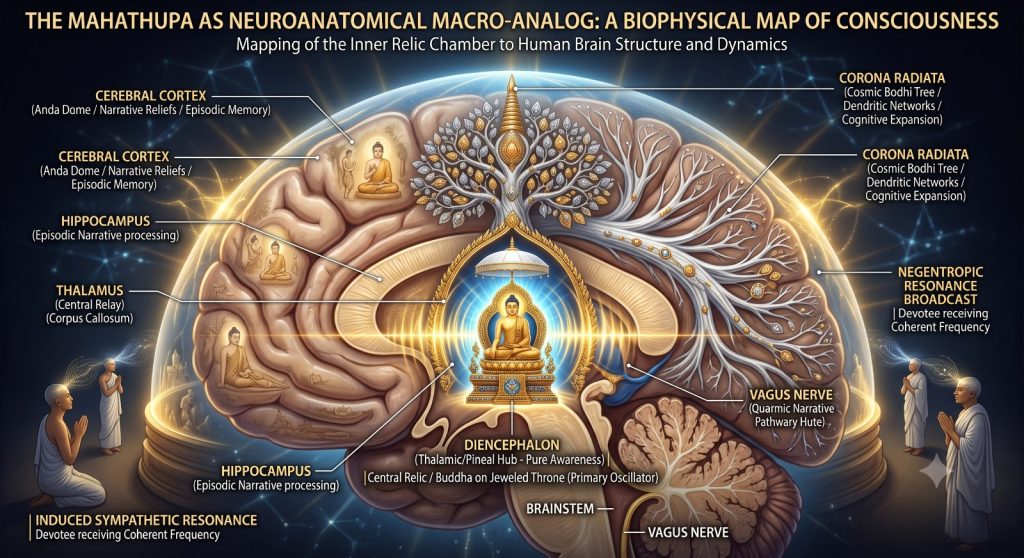
The spatial architecture of the Mahathupa’s inner relic chamber functions as a macroscopic analog to human neuroanatomy, physically illustrating the structural dynamics of consciousness. At its exact geometric center, the primary relic seated upon the jeweled throne mirrors the diencephalon—specifically the thalamic and pineal hub—serving as the primary oscillator of pure, unconditioned awareness. Ascending above it, the metallic Bodhi tree replica structurally reflects the corona radiata and sweeping dendritic networks, while the enclosing narrative reliefs correspond functionally to the cerebral cortex and hippocampus, where episodic memory and autobiographical narratives are encoded. Operating as a profound negentropic source, the central sarira utilizes the stupa’s massive hemispherical dome as a parabolic resonant cavity to broadcast a highly coherent baseline frequency. This architectural alignment allows the macro-structure of the stupa to induce sympathetic resonance within the isomorphic neural micro-structure of the circumambulating devotee, effectively bridging environmental bioacoustics with localized neurobiology.
The Temporal Mechanics of Consciousness: Orch-OR, Libet, and the Abhidhamma
To understand how this NHF impacts the devotee, we must examine the precise temporal mechanics of thought formation. Human consciousness is increasingly understood to be driven by quantum computations occurring inside the brain’s microtubules (Hameroff, 2022). According to the Orchestrated Objective Reduction (Orch-OR) model, quantum superpositions in these microtubules collapse into conscious moments in alignment with gamma synchrony—roughly 40 times per second (40 Hz). This dictates that a single, foundational moment of quantum consciousness takes approximately 25 milliseconds.
This physical metric provides a striking validation of ancient Buddhist cognitive psychology. In the Abhidhamma, a complete cognitive cycle (cittavithi)—from the moment a sensory stimulus interrupts the subconscious life-continuum (Bhavanga) to the active, karmic processing of that stimulus (Javana)—is analyzed as consisting of exactly 17 thought moments.
If we apply the quantum metric of 25 milliseconds per foundational collapse to this framework, the math aligns perfectly: 17 thought moments × 25 milliseconds = 425 milliseconds.
This 425-millisecond cognitive timeline maps almost identically onto the findings of modern neuroscience, specifically the pioneering experiments of Benjamin Libet (Libet, 1985). Libet demonstrated that the brain’s unconscious “readiness potential” begins to build roughly 300 milliseconds before a subject is consciously aware of an impending thought or action. Once conscious awareness finally arises, the subject possesses a brief window of approximately 150 to 200 milliseconds to exercise “free won’t”—the executive capacity to veto the action.
The entire neurological sequence—from unconscious initiation to the end of the conscious veto window—totals approximately 500 milliseconds. The 17-moment Buddhist cognitive cycle (425 milliseconds) fits precisely within this window.
This synthesis reveals the mechanics of how thoughts form. A thought does not spontaneously appear in consciousness; it springs up like a sudden current from the deep, flowing river of the subconscious (Bhavanga-sota). Because the first 300 milliseconds of this process occur entirely in the unconscious realm, conditioned by internal biological factors and latent tendencies, attempting to control the mind purely at the surface level is inefficient. True harmony requires structural, inner development.
Microtubular Phase-Locking and the 4C Framework
This is where the Negentropic Harmonic Field of the Mahathupa and Bodhi tree becomes neurologically vital. Under normal conditions, human microtubular oscillations are highly entropic, burdened by the chaotic conditions of the Bhavanga.
However, when a devotee enters the NHF, a phenomenon known as phase-locking (or entrainment) occurs. The highly coherent external frequencies of the stupa and tree entrain the chaotic internal frequencies of the devotee’s microtubules. This environmental intervention temporarily purifies the “river” of the subconscious, forcing the 40-Hz microtubular collapses into a state of deep neural coherence.
This localized environmental entrainment directly catalyzes the development of the individual through the 4C framework:
- Consciousness: The devotee temporarily shifts from an isolated mind into an expanded e-Consciousness, integrating seamlessly with the macroscopic order of the environment.
- Commitment: By experiencing a literal, physiological taste of absolute coherence, the abstraction of Nibbana is removed, fueling an intrinsic drive toward sustained meditative practice.
- Character: The environmental suppression of unconscious biological chaos within the first 300 milliseconds of thought formation allows the individual to operate from a baseline of resonance rather than survival-driven reactivity.
- Competence: Over time, repeated exposure to this coherent state physically alters neural pathways, building the psychological resilience required to maintain internal negentropy and exercise the 200-millisecond “veto” window effectively amid external worldly chaos.
Ultimately, the Mahathupa and Bodhi tree function as an integrated technology of consciousness—an ancient mechanism designed to environmentally force microtubular coherence and guide the human biological system toward ultimate liberation.
Prof.Dr Lakshman Madurasinghe, PhD., LLD., D Litt
References
Chaparro-Cárdenas, S. L., Ramirez Bautista, J. A., Gamboa Contreras, W., Moreno-Chacón, A. L., & Vargas-Tangua, F. C. (2021). Plant electrophysiology: bibliometric analysis, methods and applications in the monitoring of plant-environment interactions. DYNA, 88(218), 112–123. https://doi.org/10.15446/dyna.v88n218.92405
Hameroff, S. (2022). Consciousness, Cognition and the Neuronal Cytoskeleton – A New Paradigm Needed in Neuroscience. Frontiers in Molecular Neuroscience, 15. https://doi.org/10.3389/fnmol.2022.869935
Khait, I., Lewin-Epstein, O., Sharon, R., Saban, K., Goldstein, R., Anikster, Y., Zeron, Y., Agassy, C., Nizan, S., Sharabi, G., Perelman, R., Boonman, A., Sade, N., Yovel, Y., & Hadany, L. (2023). Sounds emitted by plants under stress are airborne and informative. Cell, 186(7), 1328–1336.e10. https://doi.org/10.1016/j.cell.2023.03.009
Libet, B. (1985). Unconscious cerebral initiative and the role of conscious will in voluntary action. Behavioral and Brain Sciences, 8(4), 529-566. https://doi.org/10.1017/S0140525X00044903